
Executive Summary
Deep Ocean Water (“DOW”) refers to seawater at depths below 200 metres and part of the global thermohaline circulation. Beyond the reach of sunlight, it is cold, free of the pollutants and pathogens found at the surface, and rich in essential minerals (He et al., 2014; Ha et al., 2015). Desalinated, then remineralised with DOW mineral concentrates, DOW creates drinking water with a mineral profile that conventional water sources cannot emulate.
A growing library of peer-reviewed studies, led largely by research teams in the established DOW economies of Japan, Taiwan, South Korea and the United States, has examined what this water does to the body. Mainland China, despite geographical limitations in accessing DOW, has also conducted research through offshore sampling, collaboration with Taiwan universities, and on commercially available products from Taiwan. Three benefits stand out amongst many others.
The first is faster recovery from physical exertion. In controlled human trials, people who drank DOW rehydrated twice as quickly, regained full aerobic capacity within four hours instead of two days, and kept their muscle strength through a triathlon. The second is support for the heart and blood vessels: lower blood pressure, healthier cholesterol, fewer fatty deposits in the arteries and a reduced tendency for blood to clot. The third is better handling of fat and sugar. A month-long study in adults recorded lower body fat and greater muscle mass, while animal studies show improved blood sugar control and protection against fatty liver.
What sets DOW apart from other water sources for human consumption is shown most clearly in head-to-head tests. It outperformed purified water, spring water, tap water, standard mineral water, sports drinks and surface seawater, and its mineral and trace-element-rich mix consistently did better than any single mineral on its own. Because this mineral mix can be tuned for specific purposes, DOW lends itself to a wide range of products, from recovery drinks and functional beverages to supplements and skincare.
1. What Is Deep Ocean Water?
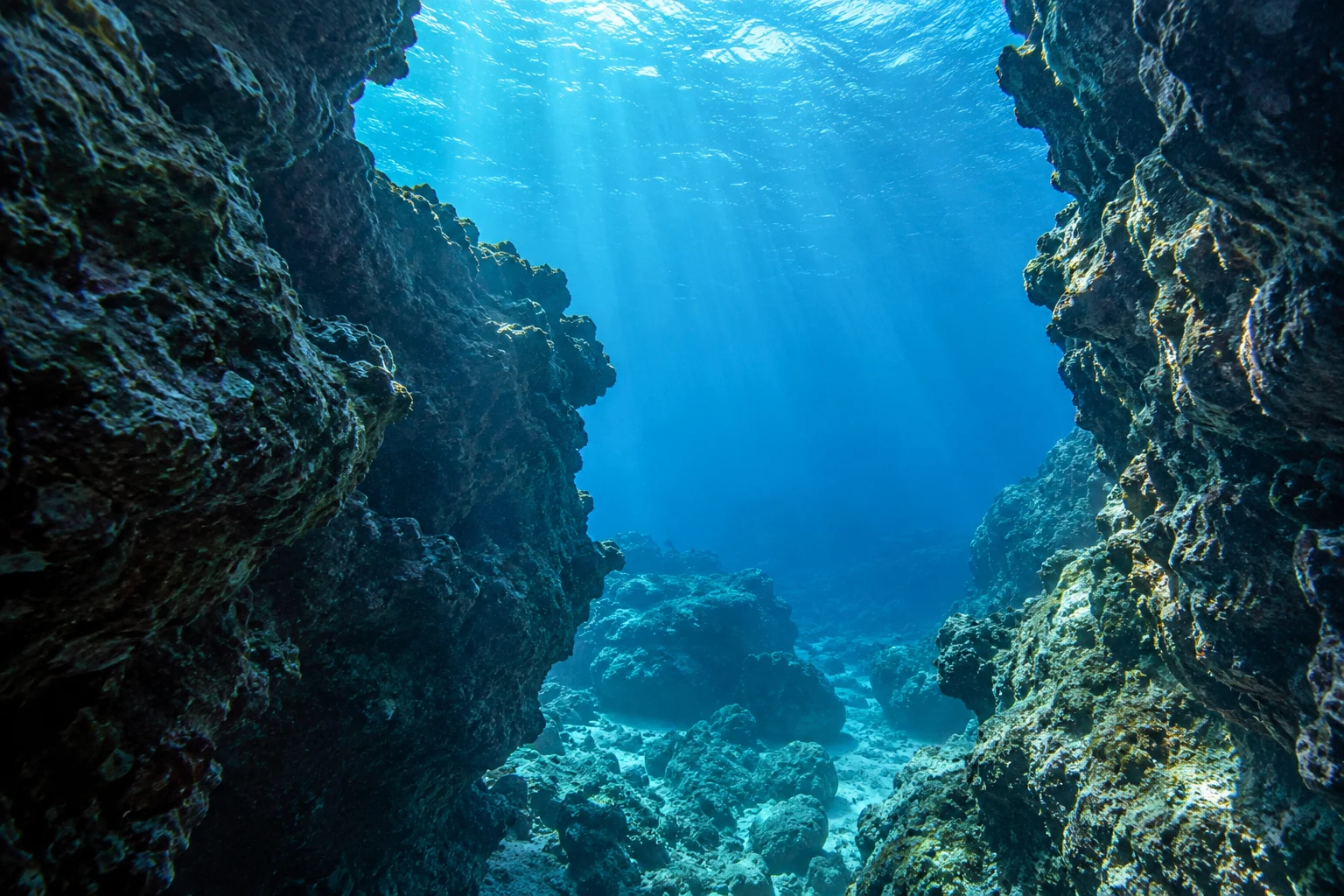
Below 200 metres, the ocean itself changes in character. Sunlight no longer penetrates, which prevents photosynthesis by the phytoplankton present in seawater, resulting in a clean, stable and microorganism-free seawater profile. Known as Deep Ocean Water, the water is inherently cold, effectively inexhaustible in supply (Ha et al., 2015), and free from the pollutants and pathogens that affect surface seawater. Minerals and nutrients that would be exhausted near the surface instead remain in a rich and stable concentration (He et al., 2014; Wang et al., 2009).
Decades of research draw on some of the world’s best-known DOW sources: 662 metres deep off Hualien, Taiwan (Hou et al., 2013); 915 metres deep off Kona, Hawaii (Keen et al., 2016); around 800 metres deep at Izu-Akazawa, Japan (Mukai et al., 2019); Toyama Bay, Japan (Takayama et al., 2026); and Goseong on the east coast of South Korea (Ha et al., 2014).
To make DOW drinkable, salt is removed through a complex system of membranes and electrodes, and minerals are processed and returned in controlled amounts (Shen et al., 2012; Ha et al., 2015). Processed DOW is used in laboratory, animal and human trials, with hardness values ranging up to 2,400.
2. What Makes Deep Ocean Water Different?
DOW carries the major minerals magnesium, calcium and potassium alongside a long list of trace elements (Ha et al., 2015; He et al., 2022). The clearest evidence of what this mineral profile can achieve for the human body comes from studies that tested DOW directly against alternatives, where DOW consistently performed better in the health measures tested.
Explore Deep Ocean Water Products
INNEOVA Life offers deep ocean mineral products from Taiwan YES, sourced from 662 metres off Hualien: the Deep Ocean Minerals Concentrate and the Deep Ocean Sea Salt. Learn more on our Ocean Resources page.
Further Reading
- “Do you need to take magnesium supplements?”, The Straits Times.
This article summarises published research for educational purposes. It is not medical advice, and individual results vary.